

If you live with hypermobile Ehlers-Danlos syndrome (hEDS) or hypermobility spectrum disorder (HSD), your pain and instability involve several things happening together.
Among those are visible changes in your fascia, muscles working overtime to hold unstable joints in place, and a nervous system that has learned to turn up its own volume on pain.
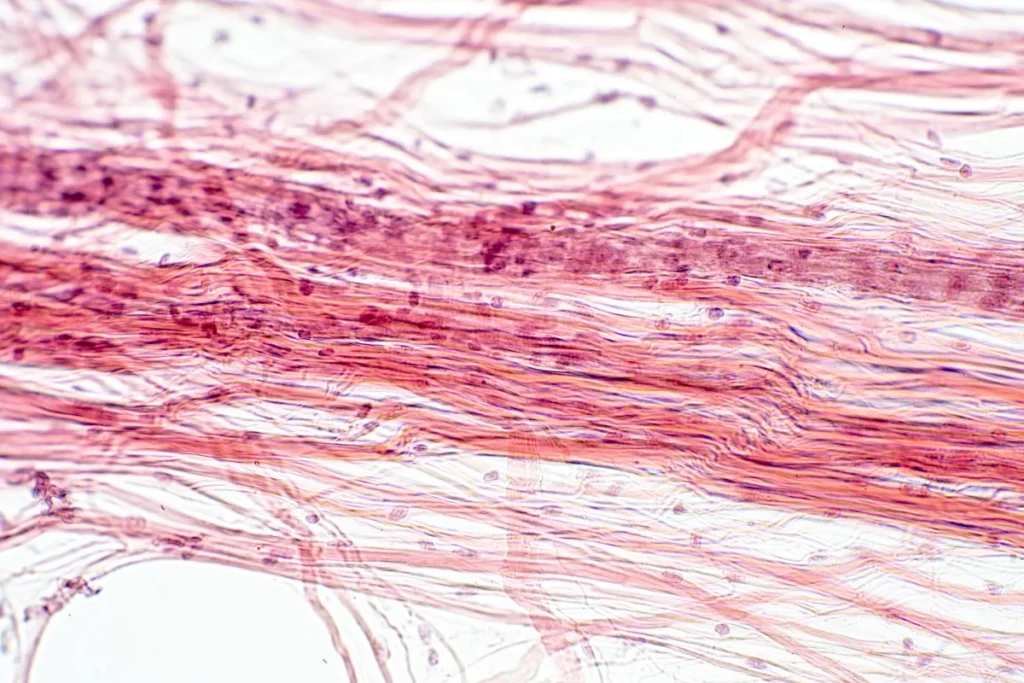
New ultrasound research has finally made the fascial piece visible, showing measurable thickening and densification in connective tissue that used to be invisible on any scan.
The Integral Movement Method (IMM) is built to work with these parts of the picture at once.
Key Takeaways
- Ultrasound research has made fascial changes in hEDS/HSD visible for the first time, showing thickened, less mobile connective tissue known as fascial densification.
- Muscles often grip and tighten as a protective response to joint and fascial laxity, creating a tight but weak pattern.
- Pain in hEDS/HSD can come from tissue changes, nerve involvement, or a sensitized nervous system, often more than one at once.
- The Integral Movement Method works with fascia, muscle guarding, and nervous system sensitization together.
What’s actually happening in your fascia?
Fascia is the connective tissue network that wraps around and connects every muscle, organ, bone, and nerve in the body, giving it structure and letting tissues glide smoothly against each other as you move.
In hEDS and HSD, the deep fascia becomes thickened and loses that normal ability to glide, a change researchers call fascial densification. Diagnostic ultrasound has finally made it visible for the first time, one of the first times what this community has been feeling has also shown up as something measurable in the body.
I’ve spent years explaining this community’s pain to people who could see nothing wrong on a scan. One of the worst aspects of living with an invisible illness is that comment “you’re fine – your scans are normal”. And then we get dismissed with no clear answers. This research changes that conversation.
When fascia doesn’t glide well, it can’t disperse mechanical load properly, and that stress gets passed on to the joints instead, which may be part of why instability, subluxations, and pain that’s hard to pin down show up together so often.
Fascia is also rich in pain-sensitive nerve endings, so thickened, stiffened fascia can irritate those too.
A 2025 review by Dr. Wang and colleagues proposes that fascia’s maintenance and repair process may not work correctly in hEDS and HSD, based on small-scale tissue biopsy studies rather than the imaging above (1): cells behave abnormally, and the material that gives fascia its structure becomes disorganized instead of staying strong and flexible.
The review connects this disruption to symptoms often treated as separate: joint instability, chronic pain, and proprioceptive difficulties among them, since fascia does several jobs at once: helping transmit force, housing pain-sensing nerves, and housing the sensors that tell your brain where your body is in space (1). That’s the review’s synthesis across several studies, not a single proven finding.

Why do your muscles feel tight when your joints are loose?
Muscles tighten in hEDS and HSD because they’re compensating for joints and ligaments that can’t provide enough support on their own. I call this false stability, and it’s the answer to a question I hear constantly: if my joints are so loose, why do I feel so tight?
Our goal with movement is to build true stability – one that relies on whole-body organization as opposed to tightness, guarding, and rigidity.
The body recruits the big global muscles to do a stabilizing job they were never designed for. They end up overworked, fatigued, and tight but weak, while the deeper stabilizing muscles that should share the load stay underused.
A fatigued muscle will always let you down – that’s why it is so important that we work on the whole body muscle tone and balance so that all the muscles do the jobs they were designed for.
Otherwise, it becomes a cycle: muscles tighten to protect lax joints, that tightness feels restrictive, we want to stretch for relief, and the stretch can destabilize the joint further, starting the cycle again. Breaking this cycle isn’t about more stretching. It’s about teaching the deeper stabilizing muscles to do their job.
There’s another mechanism worth naming here too. Some research describes thickened fascia taking over more of the load-bearing work itself, which can mean the muscles around it get used less over time (1).
That’s a different picture from muscles gripping and overworking, and researchers are still working out how both patterns fit together in a hypermobile body. Either way, the muscles need to be retrained, whether they’ve been overworking or underworking to get there.
Why does this hurt more than it “should”?
Pain in hEDS/HSD comes from three distinct mechanisms, and most people experience some combination of them. Dr. Leslie Russek, scientific advisor to The Zebra Club, calls them nociceptive, neuropathic, and nociplastic pain.
Nociceptive pain comes from actual or potential tissue stress, the kind you’d expect from a subluxation or an overstretched ligament. Neuropathic pain comes from irritation or compression of the nerves themselves, similar to what happens in carpal tunnel syndrome.
Nociplastic pain works differently: it comes from the nervous system itself becoming more sensitive, reacting more strongly to input that wouldn’t normally hurt, sometimes without any clear trigger at all.
This third type is closely tied to central sensitization, where the nervous system’s alarm system turns up its own volume.
It’s a real physiological change. For many people with hEDS/HSD, a single flare can involve all three pain types layered together, which is part of why pain here can feel disproportionate to what’s actually happening in the tissue, and why it can be so hard to explain to someone else.
Fascial change and muscle guarding explain a lot about where this pain originates. But a nervous system that has learned to sound the alarm more easily will amplify signals coming from stiffened fascia or overworked muscles, which is part of why addressing only one piece of this picture often isn’t enough.
That’s why nervous system regulation comes first in the IMM. We work on safety first, stability and strength after that has been established or calmed down.
A 2026 study of 150 adults with hEDS/HSD found that central sensitization was closely tied to three things: fatigue, pain, and cardiac dysautonomia, the autonomic symptoms common in this community (2). Anxiety and depression didn’t show that same link. This points to something physical happening in the body, not just mood.
How does IMM work with all of this at once?
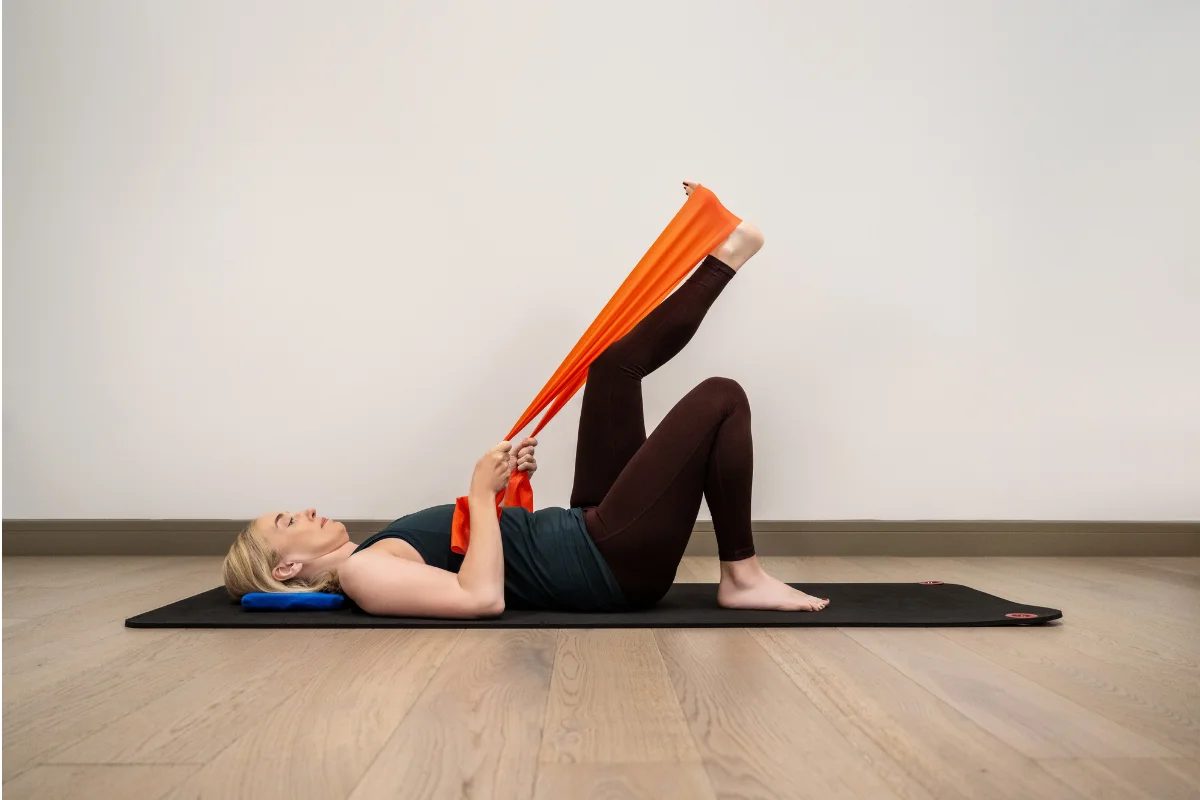
IMM works with fascia, muscle guarding, and nervous system sensitization together by sequencing six principles in a deliberate order, built for a hypermobile body. Each principle addresses a different part of the picture above.
Breath comes first: regulation before progression. A nervous system in alarm can’t build capacity, so calm comes before any movement progression begins, directly addressing the sensitization piece described above.
Relaxation follows: sequence before intensity, since hypermobile bodies often hold chronic tension as compensation for joint instability, and moving in the wrong order can increase pain.
Proprioception is next: awareness before repetition. Joint hypermobility affects the sense of where the body is in space (this is proprioception), and fascial change compounds that further, so IMM rebuilds that awareness before adding repetition.
Stability follows directly: alignment before load, targeting the muscle guarding pattern by teaching a joint to hold itself in place before resistance is added, since loading too soon is a common source of flares.
Balance and Posture complete the sequence: control before strength, and function before performance, keeping the focus on getting through daily life with energy left rather than chasing a performance benchmark.
This sequence is built for a body where fascia, muscles, and nervous system are all part of the same picture. In participant-reported outcomes, 88.2% would recommend the IMM for hypermobility. Explore the method to see how the six principles work together in more depth.
Ready to work with your body instead of against it?
Your pain and instability aren’t one thing, and they were never something to just push through.
Most exercise and physical therapy advice treats fascia, muscle guarding, and a sensitized nervous system as separate problems, or doesn’t address them at all. The Zebra Club was built around the opposite idea: that these parts of the picture need to be worked with together, in the right order, for a hypermobile body.
Ready to start? Join The Zebra Club and begin with a foundational session built around exactly this, breath, proprioception, and stability before anything else.
References
- Wang TJ, Stecco A, Hakim AJ, Schleip R. Fascial Pathophysiology in Hypermobility Spectrum Disorders and Hypermobile Ehlers-Danlos Syndrome: A Review of Emerging Evidence. Int J Mol Sci. 2025;26(12):5587.
- Montemayor Zarazúa AP, Elizondo Solis CV, Ayala García C, et al. Linking central sensitization to multisystemic manifestations in hypermobile Ehlers-Danlos syndrome. Front Pain Res. 2026;7:1799439.