
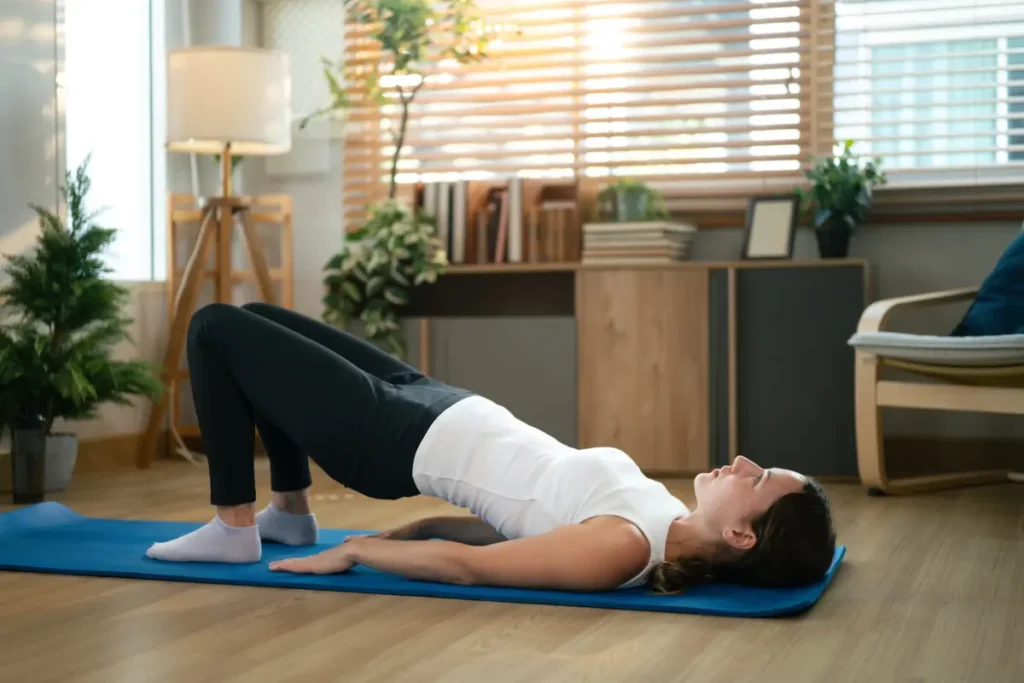
Having hypermobility doesn’t mean there’s a list of exercises you are never allowed to do. Running, jumping, weights, and fast-paced classes can all be possible once your body has the stability to support them, and pushing through fatigue tends to backfire at any stage. With hypermobile Ehlers-Danlos syndrome (hEDS) or hypermobility spectrum disorder (HSD), safer movement comes down to doing things in the right order.
We need to prepare for and ensure we have the capacity to manage the type of exercise we choose, first. In the meantime, it can help to change the pace, range, impact, or organization while you build the capacity needed.
I have worked with thousands of hypermobile people, and I always come back to the order in which we do things and build movement.
I recently made a short video about the types of exercise we shouldn’t be starting with. I didn’t say they were off the table for good, but most people would find them too challenging as a starting point.
Certain things need to be in place first, and this is the part that is often skipped in rehab. If you read the comments on the original Instagram post, you’ll see hundreds of people saying these exercises were too much for them at the time they were given. This is why order matters.
Key Takeaways
- You can work toward running, jumping, weights, and fast-paced classes with hypermobility, if you want to, once your body has the stability to support them.
- Start with breath and relaxation, then build body awareness and stability, and add strength and load last.
- While you build that capacity, change the pace, range, impact, or load of an exercise instead of pushing through.
- If exercise brings on a flare, change one thing about the session and see whether it helps.
- The Zebra Club takes you through the Integral Movement Method in this order, at your own pace.
Why order matters with hypermobility
Exercise causes problems with hypermobility when it asks loose joints to hold you up before your muscles and nervous system are ready to.
A movement can sometimes take a joint further than intended, especially if we are tired, moving too quickly, or with momentum instead of real control. Working at the end of range before developing the ability to control the movement can make this more likely.
If the body and mind do not yet understand how to organize the body through awareness and proprioception, adding in complex moves with resistance and load could lead to further joint issues like strains and muscle pulls.
Building body awareness and control first can help you feel more supported when you come to take on more challenging exercises.
Running and jumping
High-impact exercise is any movement that lands or jolts, and it sends sudden force through joints that may not be able to brace in time. These activities can create repeated impact.
This doesn’t make them wrong for everyone with hypermobility – I know many runners and dancers with hypermobility, but the speed and force of these particular movements can make them harder to manage if you do not yet have the organization and the capacity to control them.
If impact is bringing on pain, increased instability, or a flare up, try reducing or regressing the activity. Regression isn’t a bad word and doesn’t mean you are not doing well – it just means we need to step back and work on our capacity a little longer.
You could start with lower impact work and build in control and strength at a pace that feels manageable for you right now. When you feel ready, slowly add in the impact – but I mean slowly.
The aim isn’t to rule out running or jumping but to find a way back to it that feels manageable for you.

HIIT, boxing, and fast-paced classes
Fast-paced classes can be fun; they combine quick movements, changes of direction, and impact. But they can also be fatiguing, and working fast can lead to less awareness and lack of control, which could lead to an injury.
The longer the class goes on, the more fatigued we get and the less attention we pay to form and where our joints are in space.
Some people may want to work on proprioception and stability before doing these kinds of classes.
You may also be able to adapt the class by slowing down and going at your pace, not the pace of the class. Take a rest if you need to. Reduce the range of motion too. It is OK to pause and reset.
It’s always good to tell the instructor that you have symptomatic hypermobility and may take things at your own pace. Most instructors (especially the good ones) are going to be OK with that.
Yoga, Pilates, and deep stretching
End-range stretching is holding or pushing a joint to the very edge of its motion, which for a hypermobile body is often past where it can control. This is often encouraged in some yoga and Pilates spaces.
However, you don’t need to avoid yoga or Pilates just because you are hypermobile. You do need to find an instructor who really understands hypermobility. A good teacher can adapt movements to meet your strength, awareness, and control.
Avoid being pushed into end of range and overstretching – that’s where most people get injured in classes.
If your joints already move a long way, a bigger stretch isn’t always what they need. You might find it more helpful to work in a smaller range that you can control and avoid pushing yourself into positions that you can’t.
You could try making smaller movements, using supports to help you like yoga blocks or bolsters, ensuring the joints are soft and not hyperextended. And definitely let your teacher know what works for you.
Heavy lifting and CrossFit-style training
Strength training can be a really helpful part of managing hypermobility, but heavy or fast loading before stability is in place is one of the most common reasons people get hurt.
You don’t have to avoid weights if you are hypermobile, but you do need to start the right way. Don’t feel pressure to lift heavy immediately. Work on load, alignment, speed, and intensity gradually. If you need to start at 0.5 kg, that’s perfectly OK.
Lifting quickly, increasing the weight by too much of an increment, or continuing when you can feel your muscles are already tired can make it harder to control the movement. That’s when we make alignment mistakes that can cause injury.
You might want to begin with a weight you can move easily, with a range that feels comfortable. Increase slowly – don’t suddenly double the weights you are lifting.
Cross-fit style sessions can also be scaled to suit your hypermobile body. You can change the movement, make it smaller, slower, and pace it for you.

When exercise leads to a flare or crash
A post-exercise crash is a delayed rise in pain, fatigue, or other symptoms a day or two after activity, and it’s a sign the session asked for more than your body had.
Pain and fatigue can increase during or after an exercise session for different reasons. A flare does not automatically mean you have done something wrong or injured yourself.
It is not a sign you failed.
But it is a sign about how your body is responding to the activity, and we should listen to that.
Notice what changes and when. If a session leaves you feeling worse, change one thing about it and see if that makes a difference. Maybe make it shorter, slower, smaller ranges, or less weight. See if it becomes easier.
A delayed, more widespread worsening of symptoms that lasts beyond the normal recovery time could indicate post-exertional malaise (PEM), which is associated with myalgic encephalomyelitis/ chronic fatigue syndrome (ME/CFS). Especially if it comes with swollen lymph nodes, sore throat, muscle aches and pains, and cognitive impairment.
If this pattern sounds familiar and it takes you a long time to recover from exercise, it is worth speaking to a healthcare professional who understands hypermobility and ME/CFS.
What comes first: the Integral Movement Method order
The Integral Movement Method(IMM) is a nervous-system-first approach to movement for hypermobility that starts with breath and relaxation, then builds proprioception and stability before strength.
In the IMM, I think about how we prepare for movement as well as which movement we choose. I don’t see a hypermobile shoulder and think, “I know, let’s load it with a plank. That will make it stronger.” It won’t unless all the other important steps have been put in place first.
I often start with breath and relaxation, then build awareness of where the body is and how it feels to move. From there, we work on stability and control, gradually adding strength and more complex, loaded movements.
What we see in general rehab is starting with complex, loaded movements, believing that is what hypermobile joints need to ‘get stronger’. Remember, this is not just a joint condition. It is far more complex.
The aim of the IMM isn’t to avoid challenge, but it is to build you towards it in a way that respects your starting point, your symptoms and what your body needs right now.
You also don’t have to work up to any of these. Running, HIIT, and heavy lifting are options, and plenty of people never want them. For some, the goal is walking the dog without pain or looking forward to a movement class each week. I’d much rather you find a way of moving that you love and can keep doing.
Ready to build the foundation first?
If the exercises you’ve been given before felt like too much, too soon, you’re far from the only one. Plenty of people in the comments on my video said the same. Inside The Zebra Club, I take you through the Integral Movement Method from the beginning: breath and relaxation first, then building toward strength at whatever pace your body needs.